Germ of Life
Seven circles forming a six-petaled flower, representing the first rotation of creation and the foundation of growth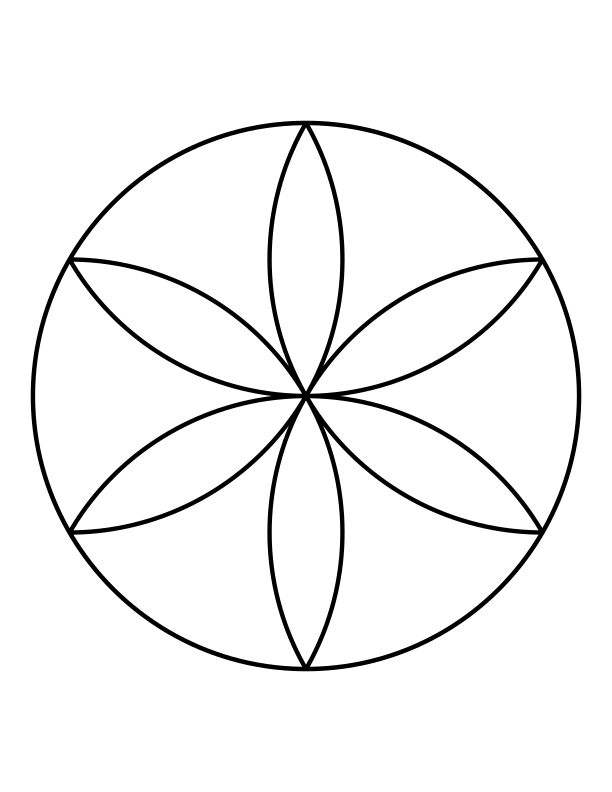
The First Rotation
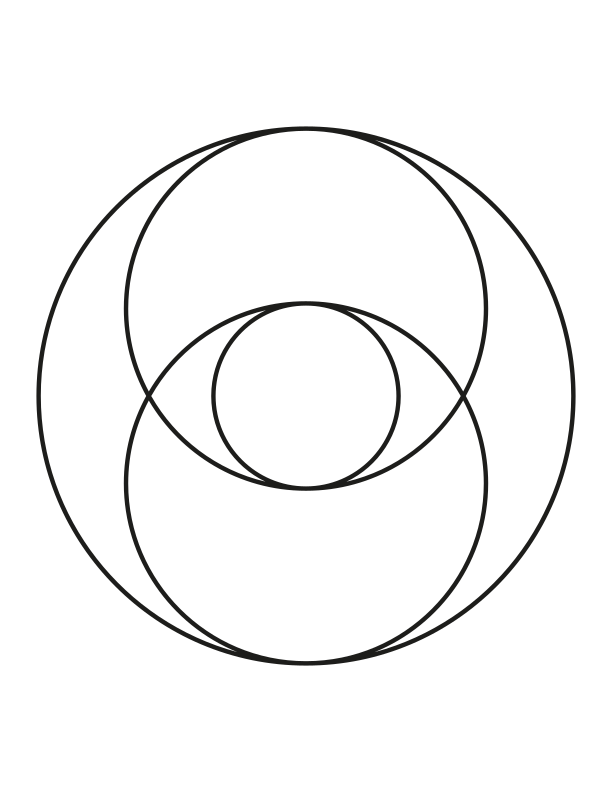
The Germ of Life represents the first rotation in the genesis of sacred geometry patterns. Created by rotating the Vesica Piscis around a central point, it generates six perfect petals arranged in hexagonal symmetry—one of nature's most fundamental patterns.
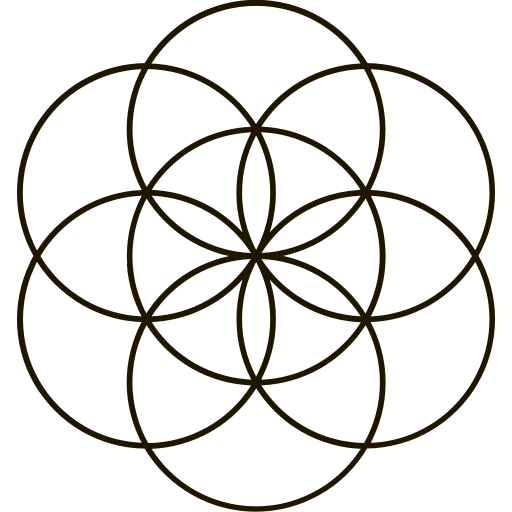
This rotation creates seven circles total: one central circle surrounded by six others. Unlike the Seed of Life where all circles overlap, the Germ of Life shows the distinct petals formed by this rotation—revealing the underlying structure of growth itself.
Foundation of Natural Growth
The six-fold symmetry of the Germ of Life appears throughout the natural world as the fundamental pattern of efficient space filling and optimal growth. This hexagonal structure appears in snowflakes, honeycombs, crystalline structures, and the molecular geometry of water.
The pattern demonstrates a universal principle: when circles of equal size pack together around a central point, they naturally form this hexagonal arrangement. This isn't arbitrary—it's the most efficient way to fill space in two dimensions.
The Gateway to Complexity
The Germ of Life serves as the foundation upon which the Seed of Life is built. While the Seed shows the complete pattern of overlapping circles, the Germ reveals the underlying rotational principle that generates the pattern.
This pattern represents the first step from unity (the single circle) through duality (the Vesica Piscis) into multiplicity—the six petals around the center. It's the geometric representation of creation unfolding from the void.
Symbolic Meaning
- Hexagonal Symmetry: The six-fold pattern appears in crystals, honeycombs, and molecular structures
- First Day: In creation narratives, represents the initial act of differentiation from unity
- Rotational Principle: Demonstrates how rotation around a center generates form and pattern
- Natural Growth: The fundamental pattern of cell division, flower petals, and organic expansion
- Space Efficiency: The most efficient packing arrangement in two-dimensional space
- Foundation Pattern: The building block from which more complex geometries emerge
Hexagonal Mathematics: Why Six Is Everywhere
Nature's persistent use of six-fold symmetry has deep mathematical roots:
Circle Packing Efficiency: When identical circles pack together in a plane, the most efficient arrangement is hexagonal—each circle touches six others. This creates the minimum wasted space. Honeybees didn't "decide" to build hexagons; physics and geometry dictated the optimal structure.
The Geometry of Six: A circle's radius exactly equals the side length of a hexagon inscribed within it. Draw a circle, mark six points on its circumference separated by 60° each, connect them—perfect hexagon. This relationship makes six-fold patterns natural, almost inevitable.
60-Degree Angle: Hexagons are composed of six equilateral triangles. Each internal angle of a hexagon is 120°, and the triangles within have 60° angles—dividing the circle (360°) into six equal parts. This makes hexagonal structures exceptionally stable.
Closest Packing: In three dimensions, spheres pack most efficiently when each sphere touches 12 others—but when we view this arrangement from certain angles, we see hexagonal patterns. The Germ of Life represents this fundamental packing principle in two dimensions.
Nature's Hexagons: From Snowflakes to Graphene
The hexagonal pattern appears throughout nature at every scale:
Snowflakes: Water molecules bond at approximately 120° angles due to hydrogen bonding geometry. When water vapor freezes into ice crystals, this molecular angle manifests as six-fold symmetry—creating snowflakes' infinite hexagonal variations. Each unique, yet all hexagonal.
Benzene and Organic Chemistry: Benzene (C₆H₆) forms a perfect hexagonal ring of six carbon atoms. This ring is the foundation of aromatic chemistry and appears in countless organic molecules—from DNA bases to neurotransmitters. Life is built on hexagons at the molecular level.
Graphene and Carbon Nanostructures: Pure carbon arranges in hexagonal lattices to form graphene (one atom thick), carbon nanotubes (rolled hexagonal sheets), and buckyballs (hexagons plus pentagons forming spheres). These hexagonal structures are among the strongest materials known.
Honeycomb: Bees build hexagonal cells because this shape uses the least wax to store the most honey with the strongest structure. The hexagonal tessellation allows perfect space-filling with no gaps—maximum efficiency through hexagonal geometry.
Giant's Causeway: When lava cools and contracts, it fractures into hexagonal columns—basalt pillars forming natural hexagonal pavements in Ireland and elsewhere. Stress dissipates most evenly through hexagonal crack patterns.
Saturn's North Pole: A massive hexagonal storm system at Saturn's north pole, photographed by Cassini. The hexagon spans roughly 20,000 miles across and persists for decades—atmospheric fluid dynamics naturally forming hexagonal standing waves.
The Rotational Principle: Motion Creates Form
The Germ of Life demonstrates a profound principle: rotation generates form:
Starting with One: Begin with a single circle—unity, the monad, undifferentiated potential.
The First Rotation: Place the compass point on the circle's circumference and draw another circle with the same radius. This circle passes through the original center—creating the vesica piscis, duality born from unity.
Continuing the Rotation: Continue placing the compass point where the previous circle intersects the original, drawing six circles total. Each new circle's center lies on the original circle's circumference, exactly one radius away from the previous center—creating overlapping vesica piscis shapes.
Hexagonal Emergence: After six rotations (6 × 60° = 360°), you return to your starting point, having created six petals around the central circle—the Germ of Life. Rotation around a center naturally generates six-fold symmetry.
The Principle Extended: This rotational principle extends infinitely. Continue rotating and creating circles, and you generate the Seed of Life, then the Flower of Life. All complex sacred geometries emerge from simple rotation around a center—motion creating form, the dynamic principle underlying static pattern.
Crystallography and Six-Fold Symmetry
In materials science, hexagonal structures are fundamental:
Hexagonal Crystal System: One of the seven crystal systems in mineralogy. Crystals like quartz, beryl (emerald, aquamarine), and ice crystallize in hexagonal structures. The six-fold rotational symmetry repeats at atomic scales.
Graphite: Before becoming diamond (cubic), carbon exists as graphite—layers of hexagonal carbon sheets that slide past each other (making graphite slippery and useful for pencils). Same element, different geometry, completely different properties.
Ice Ih Structure: Normal ice (Ice Ih) has hexagonal crystal structure. This is why snowflakes have six-fold symmetry and why ice floats (hexagonal packing creates more space between molecules than liquid water's random arrangement).
Wurtzite Structure: Many semiconductors (like zinc oxide, gallium nitride) crystallize in wurtzite structure—hexagonal arrangements that enable their electronic properties, making modern LEDs and lasers possible.
Close-Packed Structures: In metallurgy, hexagonal close-packed (HCP) structures appear in metals like titanium, magnesium, and zinc. The atoms arrange in repeating layers following hexagonal geometry, providing specific mechanical properties.
Six in Sacred Traditions
The number six carries symbolic weight across spiritual systems:
Star of David (Hexagram): Two overlapping triangles create six points—the Magen David in Judaism, representing the union of divine (downward triangle) and human (upward triangle), heaven and earth in balance. The hexagram itself can be inscribed in a hexagon.
Six Days of Creation: Genesis describes creation in six days, with the seventh as rest. Six represents labor, manifestation, the work of bringing form into being. The Germ of Life's six petals mirror these six creative acts.
Vishnu's Wheel (Sudarshana Chakra): In Hinduism, Vishnu's weapon/symbol has six spokes, representing the six seasons of the Hindu calendar and the six philosophies (darshanas) of Hindu thought.
Six Directions of Space: North, South, East, West, Up, Down—the six cardinal directions define three-dimensional space. The hexagon, when rotated in 3D, generates the octahedron (8 faces, 6 vertices)—the six directions becoming eight faces.
Islamic Geometry: Six-fold patterns appear extensively in Islamic art and architecture—mosques feature hexagonal star patterns, recognizing the mathematical beauty and spiritual significance of six-fold symmetry.
From Germ to Seed: The Geometric Progression
The Germ of Life is the precursor to more complex sacred patterns:
Germ → Seed: The Germ of Life shows the rotational structure—six petals around a center. When you recognize that these seven circles fully overlap (not just touch at edges), you have the Seed of Life. The Germ reveals the process; the Seed reveals the result.
Seed → Flower: Continue rotating, adding more circles following the same rule (each new circle's center placed where circles intersect), and the Seed blossoms into the Flower of Life. The principle established in the Germ extends infinitely.
Foundation of All Patterns: Every complex sacred geometry contains the Germ of Life within it. Find the center, look for the six-fold petals, and you'll find the Germ—the foundational pattern from which complexity grows. It's the geometric DNA, the code that generates all subsequent forms.
Motion and Stillness: The Germ represents the transition from stillness (the single circle) to motion (rotation creating pattern). In spiritual terms, it's the first movement of consciousness—the One observing itself, creating the Many through the act of observation.
Meditation: The Six-Petaled Lotus
Working with the Germ of Life in contemplation:
Hexagonal Breath: Visualize the Germ of Life—six petals surrounding a center. Assign each petal a quality: love, wisdom, strength, compassion, clarity, peace. Breathe into each petal sequentially, then rest in the center—the unified source of all six qualities.
Rotation Meditation: Close your eyes and visualize a single point. From that point, begin rotating—imagine yourself as the compass drawing circles. Feel how motion creates form, how turning generates pattern. Return to stillness at the center—the unmoving point around which all revolves.
The First Flower: The Germ of Life is sometimes called the "first flower"—six petals around a center, like a simple blossom. Meditate on this as your own flowering: six aspects of self (physical, emotional, mental, intuitive, creative, spiritual) blooming around your core essence.
Space-Filling Practice: Contemplate how hexagons tile perfectly—no gaps, maximum efficiency. Bring this principle into your life: How can you organize your time, energy, and resources with hexagonal efficiency? Where can you eliminate gaps and create seamless integration?