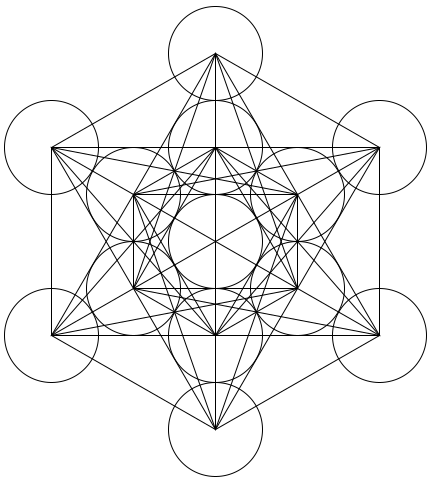
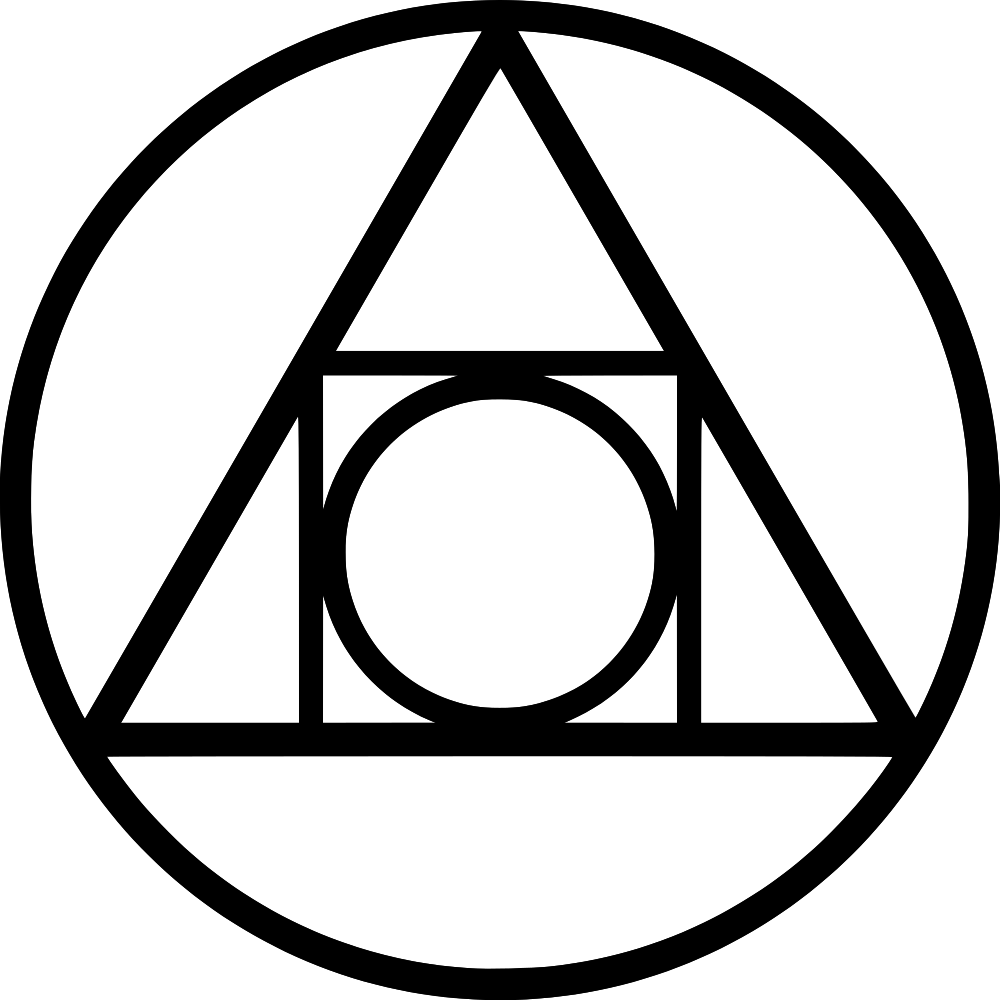
The Hexahedron (Cube): Foundation of Earth
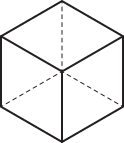
The hexahedron, commonly known as the cube, represents the element of Earth—stability, structure, and the material world. It is the most grounded of all Platonic Solids.
Visual Representations
Mathematical Properties
Associations
Symbolic Properties
The cube embodies the principle of stability through right angles. Its six square faces represent the six directions of space—up, down, left, right, forward, and backward. In sacred geometry, it symbolizes:
Key Associations:
- Material reality and physical manifestation
- Grounding and stability, like the foundation of a building
- The Root Chakra, our connection to Earth and security
- The four elements plus above and below
Mathematical Insights
The cube is unique among Platonic Solids for its perpendicular faces. Every edge meets every other edge at exactly 90 degrees, creating perfect stability. This is why we build our homes and cities using cubic forms—they naturally resist gravitational forces and provide maximum usable space.
Dual to the Octahedron
The cube and octahedron are geometric duals—perfect complements in the language of polyhedra. When you place a point at the center of each face of a cube and connect them, you create an octahedron. This duality represents:
- Earth and Air: Material and mental, form and thought in balance
- Stability and flexibility: The rigid cube meets the dynamic octahedron
- Six and eight: The interplay between directions of space (6) and triangular faces (8)
The cube provides the container; the octahedron provides the contents. Together they represent the relationship between structure and energy, between the vessel and what it holds.
The Cube in Sacred Architecture
The cubic form appears in the most sacred structures across cultures, representing the perfected material world:
The Kaaba (Mecca): Islam's holiest site is a perfect cube draped in black silk. Muslims worldwide orient their prayers toward this cubic center, making it the axis mundi—the world's spiritual pivot point.
The Holy of Holies (Jerusalem): The innermost chamber of Solomon's Temple was a perfect cube—20 cubits on each side. This cubic sanctuary housed the Ark of the Covenant, representing the intersection of divine and earthly realms.
The New Jerusalem (Revelation): Biblical prophecy describes the perfected heavenly city as a cube: "The city lies foursquare, its length the same as its width... 12,000 stadia in length and width and height." The cube as the ultimate sacred architecture of paradise.
Freemasonry: The cubic stone represents the rough ashlar (imperfect human) being transformed into the perfect ashlar (enlightened being)—transformation through discipline and right angles.
Cubic Crystal Systems
The cube is one of the seven crystal systems that organize all mineral structures on Earth:
Halite (Salt): Sodium chloride (NaCl) naturally crystallizes into perfect cubes. When you see table salt under magnification, you're looking at tiny perfect cubes—geometry encoded at the atomic level.
Pyrite (Fool's Gold): Iron sulfide forms spectacular natural cubes and octahedra. Some specimens show both forms simultaneously, demonstrating their dual relationship in solid crystal.
Fluorite: Calcium fluoride forms cubic crystals in brilliant colors—purple, green, blue, yellow. These cubic gems demonstrate how minerals follow geometric laws of formation.
Diamond Cubic Structure: While individual diamonds form octahedrons, their internal atomic lattice follows cubic symmetry—another expression of the cube-octahedron duality.
The Philosophy of Right Angles
The cube embodies the principle of perpendicularity—every edge meets every face at exactly 90 degrees. This represents:
Orthogonality in Thought: Just as perpendicular lines are independent in mathematics, the cube teaches us to separate and organize concepts clearly. Each dimension operates independently yet contributes to the whole.
The Three Dimensions of Reality: Length, width, and height—the three axes of space find their perfect expression in the cube. We build our understanding of physical reality on these three perpendicular dimensions.
Moral Rectitude: The phrase "square deal" and being "on the level" come from masonic symbolism of the cube and square. Right angles represent fairness, honesty, and moral straightness.
Cartesian Coordinates: Our scientific understanding of space uses cubic coordinates (x, y, z). The cube is literally the framework through which we map and measure reality.
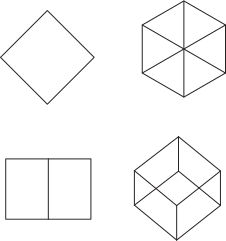
The Cube Unfolded: Nets and Dimensions
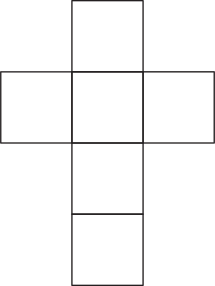
When you unfold a cube into two dimensions, you create a net—a flat pattern that can be folded back into three-dimensional form. There are exactly 11 distinct nets that can form a cube.
Dimensional Analogy: Just as a three-dimensional cube can be unfolded into a two-dimensional cross, perhaps our three-dimensional reality is the "unfolding" of a higher-dimensional structure. This concept appears in:
- Tesseracts: The four-dimensional hypercube, which when "unfolded" into 3D creates nested cubes
- Salvador Dalí's Crucifixion: His painting shows Christ on an unfolded hypercube—the cross as a higher dimensional symbol
- String Theory: Some models propose extra dimensions "curled up" in cubic or toroidal geometries
The cube's relationship to its net demonstrates how higher dimensions might fold and unfold—a geometric key to understanding dimensional transcendence.
Building Blocks of Civilization
The cube is humanity's primary building block:
Architecture: We construct buildings using cubic rooms, cubic blocks, cubic bricks. The cube provides maximum usable space with minimum material and maximum stability.
Storage and Packaging: Cubic shapes stack efficiently without wasted space. From shipping containers to city blocks, the cube optimizes space utilization.
Dice and Games: The six-sided die—a perfect cube—has been used for games and divination for thousands of years. Each face equally likely, representing fair chance.
The Grid: City planning on cubic grids (Manhattan, ancient Roman cities) organizes human life along perpendicular axes—the cube extended across the landscape.
Meditation: The Cube of Space
In Kabbalistic meditation, the Cube of Space represents the structure of consciousness itself:
The Six Directions: Each face represents one of the six directions—above, below, east, west, north, south—mapping the totality of experiential space.
The Twelve Edges: The twelve edges correspond to the twelve signs of the zodiac, representing twelve modes of consciousness and twelve paths of manifestation.
The Center: At the cube's center sits the observer—the awareness witnessing all directions, all polarities, all manifestations, while remaining unmoved at the still point.
Practical Visualization: Meditate within an imagined cube of light. Feel its stability, its definition, its clear boundaries. The cube teaches us to establish sacred space, to create containers for consciousness, to build the temple of the self.