Philosopher's Stone
Ancient alchemical symbol representing spiritual transformation and the union of opposites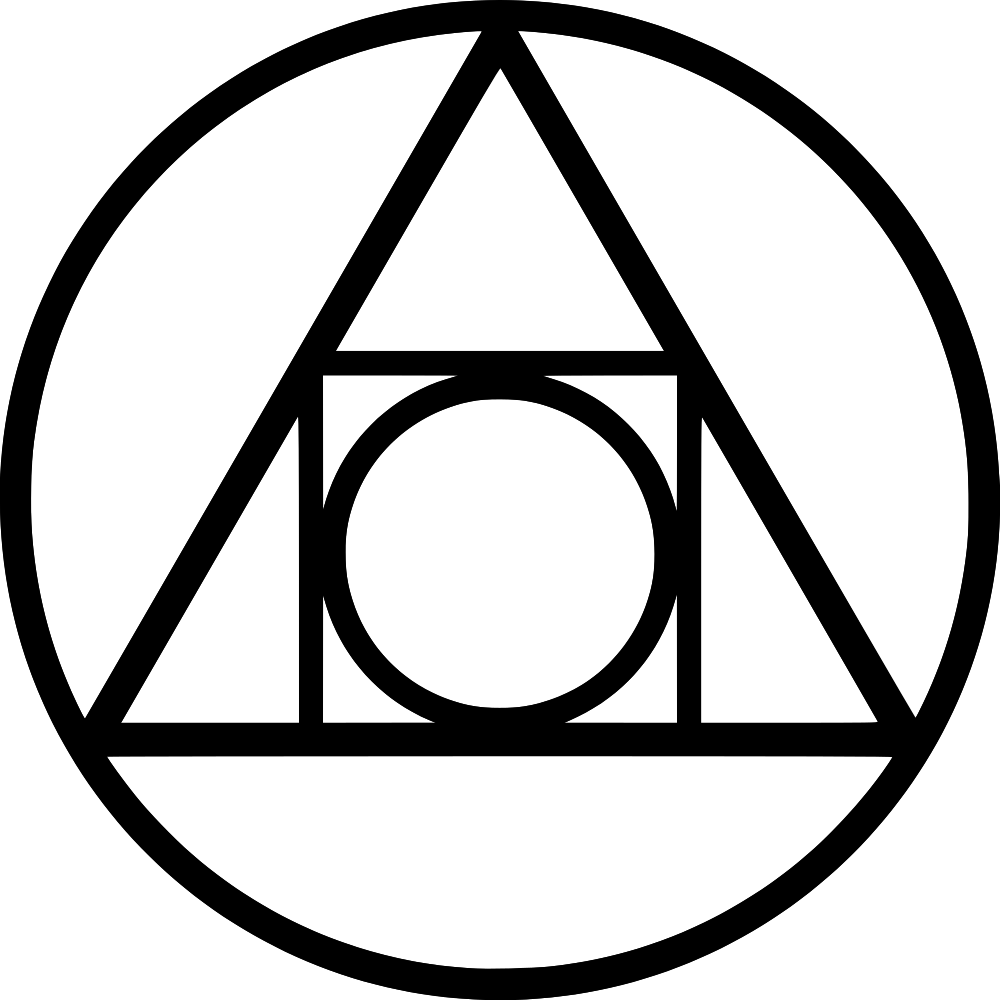
The Great Work
In alchemy, the Philosopher's Stone represents the culmination of the Great Work (Magnum Opus)—the transformation of base metals into gold, and symbolically, the transformation of the base human condition into spiritual enlightenment. While many sought it as a physical substance, the true alchemists understood it as a metaphor for inner transformation.
The geometric symbol of the Philosopher's Stone typically features a circle squared, or a square circled—representing the union of heaven (circle) and earth (square), spirit and matter, the eternal and the temporal. This "squaring of the circle" is an ancient geometric puzzle that symbolizes the impossible made possible through spiritual work.
Union of Opposites
Central to the Philosopher's Stone is the concept of "coincidentia oppositorum"—the coincidence of opposites. The alchemical process involves the marriage of opposing forces: masculine and feminine, sun and moon, sulfur and mercury, active and passive, conscious and unconscious.
The geometric representation often includes overlapping triangles (like the Star of David), circles within squares, or other forms that demonstrate the integration of seemingly contradictory principles. This geometric integration mirrors the internal work of unifying the disparate aspects of the self.
Alchemical Symbolism
- Spiritual Transmutation: The transformation of consciousness from lead (heavy, base) to gold (illuminated, refined)
- The Squared Circle: Represents the reconciliation of the infinite (circle) with the finite (square)
- The Elixir of Life: Tradition holds that the Philosopher's Stone could create an elixir granting immortality and perfect health
- The Prima Materia: The original substance from which the Stone is created, representing the raw material of consciousness
- Sacred Marriage: The alchemical wedding (hieros gamos) of opposites to create something greater than either alone
- Solve et Coagula: "Dissolve and coagulate"—the process of breaking down and rebuilding the self in purified form
The Alchemical Process: Stages of Transformation
The creation of the Philosopher's Stone follows a precise sequence—the Magnum Opus (Great Work)—traditionally described in four major stages:
Nigredo (Blackening) - Death: The first stage is dissolution and decomposition. The prima materia (raw material) must be broken down completely, confronting darkness, shadow, and the death of the ego. In psychological terms, this is facing your shadow self—all that you've repressed or denied. Black symbolizes the void, the fertile darkness from which new life emerges.
Albedo (Whitening) - Purification: After dissolution comes washing and purification. The darkness gives way to brilliant whiteness—clarity, cleansing, the burning away of impurities. This stage represents spiritual awakening, the light of consciousness illuminating what was hidden. The alchemist describes "washing the blackness" until only pure essence remains.
Citrinitas (Yellowing) - Dawn: Some traditions include this intermediate stage between white and red—the yellowing or dawning. It represents the first glimpse of the gold to come, the sunrise after the dark night, the integration beginning to occur. Consciousness transforms from mere awareness (white) toward wisdom (gold).
Rubedo (Reddening) - The Ruby: The final stage—reddening—represents completion. The Philosopher's Stone appears as a ruby-red powder or crystal. Red symbolizes vitality, life force, blood—the full integration of spirit and matter, the divine incarnate. The Stone has been created; lead can now become gold; the base self has become illuminated.
Circular Nature: These stages don't proceed linearly but spiral—each completion becomes a new prima materia for deeper work. The Great Work is never truly finished; each transformation reveals new depths to explore.
Squaring the Circle: The Impossible Made Possible
The geometric symbol of the Philosopher's Stone—a square and circle of equal perimeter or area—represents an ancient mathematical puzzle:
The Mathematical Challenge: To "square the circle" means constructing a square with the same area as a given circle using only compass and straightedge. Mathematicians proved in 1882 that this is impossible because π is transcendental (cannot be expressed as a finite sequence of algebraic operations).
The Symbolic Truth: Yet alchemy embraces this impossibility as profound symbolism. The circle represents:
- The infinite, eternal, divine, heavenly
- Continuous motion, cycles, the feminine
- Spirit, consciousness, the unlimited
The square represents:
- The finite, temporal, earthly, material
- Stability, foundation, the masculine
- Matter, body, the limited
The Alchemical Solution: To square the circle is to reconcile these opposites—not through mathematics but through consciousness. The Philosopher's Stone represents the state where spirit and matter unite, where the impossible becomes possible through transformation rather than calculation.
Geometric Constructions: Alchemical texts show various "squared circles"—a circle inscribed in a square, a square inscribed in a circle, or overlapping figures. Each represents a different relationship between the infinite and finite, the divine and material realms.
Carl Jung and Psychological Alchemy
The psychologist Carl Jung dedicated years to studying alchemy, recognizing it as a map of psychological transformation:
The Stone as the Self: Jung interpreted the Philosopher's Stone as a symbol for the Self—not the ego (the conscious "I") but the totality of consciousness, the integration of all aspects of the psyche into wholeness.
Individuation Process: Jung's concept of individuation—becoming who you truly are—mirrors the alchemical process:
- Nigredo = Confronting the shadow (unconscious contents)
- Albedo = Integration of the anima/animus (inner masculine/feminine)
- Citrinitas = The dawning of the Self
- Rubedo = Full realization of wholeness
Coniunctio Oppositorum: The "conjunction of opposites"—uniting conscious and unconscious, light and shadow, masculine and feminine, spirit and instinct—creates the philosophical gold. This union doesn't eliminate polarity but transcends it.
Modern Alchemy: Jung demonstrated that alchemy wasn't primitive chemistry but sophisticated psychology. The external work (laboratory alchemy) reflected internal work (spiritual transformation). Medieval alchemists were unconsciously mapping the individuation process through chemical symbolism.
The Stone Within: You don't find the Philosopher's Stone—you become it. The transformation of lead to gold is the transformation of the unconscious, unrealized person into the conscious, fully individuated Self.
Historical Alchemists and Their Quests
Throughout history, brilliant minds pursued the Philosopher's Stone, driven by both material and spiritual motivations:
Hermes Trismegistus (Legendary): The mythical founder of alchemy, merging the Greek god Hermes with the Egyptian Thoth. The Emerald Tablet attributed to Hermes contains the famous maxim: "As above, so below"—the principle that the macrocosm reflects the microcosm.
Nicolas Flamel (1330-1418): French scribe who claimed to have successfully created the Philosopher's Stone. Legend says he and his wife Perenelle achieved immortality through the Stone's elixir—some claim to have seen him alive centuries after his supposed death.
Paracelsus (1493-1541): Swiss physician who revolutionized medicine by applying alchemical principles to healing. He viewed the human body as an alchemical vessel and disease as imbalance requiring transmutation through properly prepared medicines (spagyric medicine).
John Dee (1527-1608): English mathematician, astronomer, and astrologer to Queen Elizabeth I. Dee pursued both physical alchemy and angelic communication, seeking the Stone through spiritual revelation as much as laboratory work.
Isaac Newton (1643-1727): History concealed Newton's obsession with alchemy—he wrote over a million words on the subject, more than on physics or mathematics. His scientific revolution may have been inspired by alchemical thinking about hidden forces and universal laws.
Mary the Jewess (1st-3rd century CE): One of the first named alchemists, she invented laboratory equipment still used today (the double boiler or "bain-marie"). Her work bridged practical chemistry and spiritual transformation.
The Secret Tradition: Many alchemists worked in secret, fearing persecution by the Church or exploitation by greedy rulers. They encoded their knowledge in obscure symbols and cryptic texts—making the true wisdom accessible only to the initiated.
Inner Alchemy: Practical Transformation
Modern applications of alchemical wisdom for personal transformation:
Daily Practice:
- Morning Nigredo: Sit with what's difficult—journaling shadow aspects, facing fears, acknowledging pain without fleeing
- Albedo Cleansing: Meditation, breathwork, or contemplation—washing awareness clean, creating inner clarity
- Citrinitas Integration: Study, reflection, assimilating insights—connecting the dots, finding meaning
- Rubedo Embodiment: Living your truth—taking action aligned with your realization, incarnating wisdom
The Alchemical Marriage: Practice uniting opposites within yourself:
- Masculine/Feminine: Honor both your action-oriented (yang) and receptive (yin) aspects
- Light/Shadow: Integrate both your virtues and your darkness into wholeness
- Spirit/Body: Don't transcend the body but sanctify it—spirit incarnate
- Thinking/Feeling: Balance rational analysis with emotional intelligence
Transmuting Base Metals: What are your "base metals"—patterns, fears, wounds that weigh you down?
- Lead of Depression: Transform heaviness into the gold of wisdom through suffering
- Iron of Anger: Forge your anger into the steel of boundaries and justice
- Mercury of Anxiety: Refine quicksilver restlessness into agile awareness
- Copper of Desire: Alchemize attachment into appreciation and love
Creating the Vessel: The alchemical vessel (alembic) symbolizes creating a container for transformation—a disciplined practice, a sacred space, a commitment to the work. You cannot transform what you cannot contain.
Solve et Coagula: Repeatedly:
- Dissolve (solve): Break down rigid patterns, certainties, false self-images
- Coagulate (coagula): Rebuild with greater consciousness, flexibility, authenticity This rhythm of dissolution and reformation is the heartbeat of transformation.
The Stone in Sacred Geometry
The Philosopher's Stone connects to other sacred geometric patterns:
The Squared Circle: As mentioned, the Stone's primary symbol—circle and square united—appears throughout sacred geometry: mandalas with circular borders and square centers, temple architecture combining dome (circle) with foundation (square), the union of celestial and terrestrial geometries.
The Vesica Piscis: The alchemical marriage (coniunctio) is represented by two overlapping circles—the vesica piscis, the womb from which the Stone is born. Two becoming one while remaining two—the mystery of union.
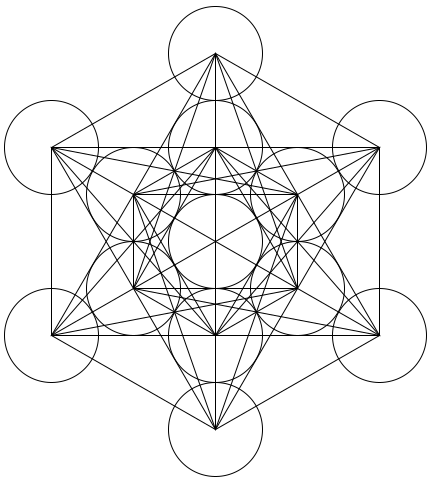
Metatron's Cube: The transformation from Fruit of Life (13 circles) to Metatron's Cube (connecting lines forming Platonic Solids) mirrors the alchemical transformation from prima materia (undifferentiated substance) to the perfected Stone (all elements in harmony).
The Golden Ratio: The Philosopher's Stone represents perfect proportion—not too much fire (destruction), not too little (stagnation), but the golden mean of balanced transformation. The Stone embodies φ—the ratio of harmonious growth.
Mandala Integration: Many alchemical manuscripts feature circular diagrams—mandalas showing the stages of the Great Work. The center represents the Stone itself, the integration point where all opposites reconcile.